This page is a hub for information about the Devolution and Local Government Reorganisation (LGR) programmes.
Please do check back for information, and use the links on the side of this page for additional details too.

What is Local Government Reorganisation?
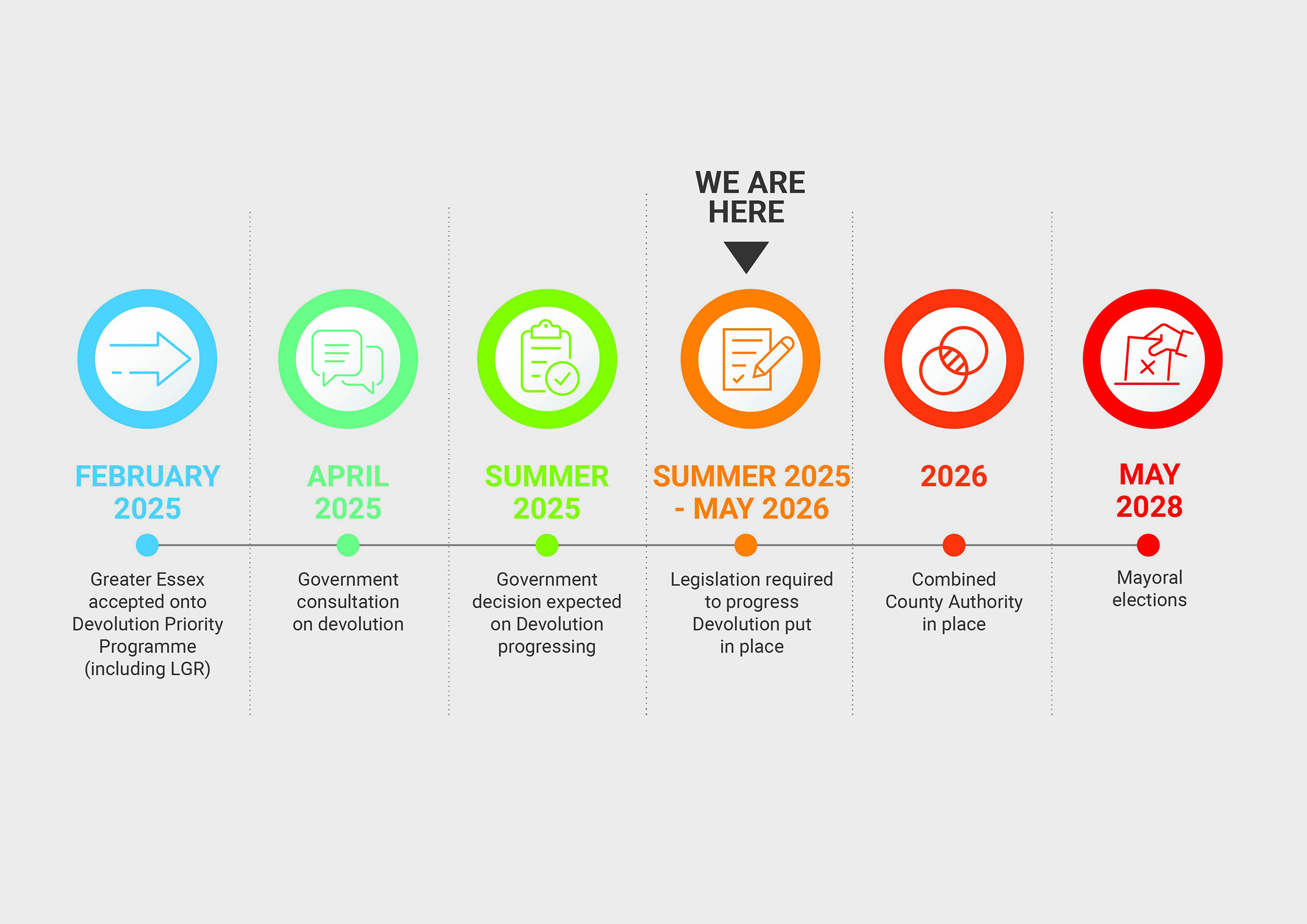
What is the expected timeline?
What is the Tendring position?
What does this mean for me as an employee of Tendring District Council?
What does this mean for me as a Member of the council?
Devolution involves setting up a new “combined authority” (CA) for Greater Essex. The CA would be led by representatives of Essex County Council and the unitary councils of Thurrock and Southend.
One option for new combined authorities is to also include a new directly elected Mayor. The CA (with the Mayor, if there is one) takes on powers and budget ‘devolved’ to it by central government, for example over skills funding.
The Combined Authority may also be referred to as a Strategic Authority.
It is central government (the Secretary of State for Housing, Communities and Local Government) who will make the decision on whether we go ahead with Devolution and LGR. The Secretary of State will also decide what option for the number of unitaries and the boundaries of those unitaries is taken.
Wider engagement has been carried out with residents, stakeholders, parish and town councils, businesses and so on.
Once any new unitaries are in place – whether that be three, four or five across Essex – these would be the constituent members of the Strategic Authority (as Essex County Council, Thurrock Council and Southend City Council would no longer exist).
The English Devolution White Paper makes it clear that alongside devolution, there is a need to consider the opportunities and implications of Local Government Reorganisation.
It brings powers and funding from central government to local areas. It can help improve local services, better transport links and more tailored economic growth strategies.
Funding would be a combination of devolved money from government; levies charged to the councils that make up the authority (Essex, Thurrock and Southend at present, see LGR section below); and a charge on the council tax precept.
The Strategic Authority, led by the elected mayor, would have powers and funding to look at sub-regional issues such as: transport and local infrastructure; skills and employment support; strategic planning for housing growth; economic development and regeneration (as part of a Local Growth Plan); environment and climate change; health, wellbeing and public service reform; and public safety.
Local Government Reorganisation - sometimes referred to as Local Government Reform (LGR) or unitarisation - means replacing the current two-tier system (county and district councils) with single-tier authorities; single councils responsible for all local government statutory duties in the area.
In Essex, this would mean setting up new unitary councils, which would have the responsibilities of both Essex County Council and the district councils (like Tendring) in one authority - though some duties and powers may be moved to the Combined Authority as part of Devolution (see the section on Devolution). Examples of existing unitary councils are Thurrock and Southend.
A Shadow Authority is effectively a Council with very limited powers. Councillors are elected to the Shadow Authority; however their role is restricted to making the necessary decisions to establish the new Council so it can make decisions from its first day of operation, "Vesting Day".
This is when the new authorities go live in legal terms, with all the powers other Councils have; and the old councils are abolished. The Shadow Authority is in place for around a year prior to Vesting Day.
The Shadow Authority will work in a similar way to a Council, with meetings (including a Shadow Executive, or Cabinet equivalent). The Shadow Authority will agree the Constitution for the new Council, the budget for its first year of operation and will also appoint Statutory Officers (Head of Paid Service, Section 151 Officer and Monitoring Officer) and other senior officers.
The Shadow Authority cannot award contracts or take other decisions, such as Planning, Licensing and so on; this remains with the legacy Councils (such as Tendring District Council) until Vesting Day. However, the Shadow Authority is likely to be required to give its approval to some decisions Tendring District Council (and other members) make will impact the new authority. This would include the award of new contracts and disposal of assets.
It is central government (the Secretary of State for Housing, Communities and Local Government) who will make the decision on whether we go ahead with Devolution and LGR. The Secretary of State will also decide what option for the number of unitaries and the boundaries of those unitaries is taken.
Wider engagement has been carried out with residents, stakeholders, parish and town councils, businesses and so on.
This is something that is being discussed across Greater Essex councils – so far the government have confirmed there would be no write off of debt from central government and it would be for the new unitaries to deal with.
It brings opportunities around being a central reference point for public services, improved value for money and efficiency, boost economic growth, provide more efficient council structures around communities and governance, scale in service delivery and having a stronger voice to central government.
Options for what unitary Tendring could be part of were detailed in the September submission to government and it will ultimately be government’s decision. We’ll continue working with all councils in Greater Essex so we can understand the evidence base for any proposed changes to Council structures, to maximise the benefits and so it delivers the best outcome for our residents and businesses.
There were four options submitted. In two of these Tendring is with Braintree and Colchester (five unitary model, and Rochford's four unitary model); in a third with these two and Uttlesford (the three unitary model); and in the fourth, Tendring is with Maldon and Colchester (Thurrock's four unitary model).
We have been working particularly closely with Colchester City Council (as our only shared border, and partner in all of the options), and Braintree District Council, as well as Essex County Council.
The English Devolution White Paper makes it clear that alongside devolution, there is a need to consider the opportunities and implications of Local Government Reorganisation.
As part of the transition process, a cross-Essex implementation group will be established to manage the process.
At a councillor level, this work is complemented by (first) a Joint Committee between existing councils in the new area, and then (later) the new council in ‘shadow’ form.
The role of these bodies is to coordinate preparation and ensure services can move across safely and smoothly. This work is focused on continuity, stability and good planning, and would involve staff, unions and partners in a measured and transparent way.
It is not anticipated that there would be any significant changes to how services operate in the early stages, because the focus will be on establishing the new councils.
Government consulted on four options for reorganising councils in the area:
All options would replace existing district, borough, city, and county councils with fewer all‑purpose unitary authorities.
Four proposals for Greater Essex were submitted in September 2025 and were consulted on between November 2025 and January 2026.
Government is considering replacing the current two-tier system of councils (with districts underneath county councils) with a smaller number of unitary councils that would deliver all local services in their areas.
The government published a White Paper – a piece of policy – on English Devolution on 16 December 2024, setting out its proposals.
It sets out an ambition for all areas of England to have a Strategic Authority, and an expectation that all two tier areas (such as ours) develop proposals for LGR. Essex is in the Priority Programme for Devolution and LGR.


The process of LGR is complex and will require careful planning to ensure a smooth transition. We will continue to deliver services while shaping our new organisation. It’s essential we maintain service continuity to meet the needs of our community.
It’s likely additional resources will be allocated where necessary to support the work around reorganisation.
At this stage we have to work on the basis that they will do. However, if LGR goes ahead, then it may be that in May 2027 we will see elections to the shadow, new unitary authority; while terms of office for TDC councillors would be extended by a year to see out the transition period until ‘vesting day’ (when a new unitary authority takes over).
Parish and town council elections scheduled for May 2027 may continue as planned (with their terms also potentially extended by a year to align with the next new unitary elections).
No. Even if new unitaries are in place by then, the actual process of harmonising policies, systems and so on is likely to take years longer.
A Shadow Authority is effectively a Council with very limited powers. Councillors are elected to the Shadow Authority; however their role is restricted to making the necessary decisions to establish the new Council so it can make decisions from its first day of operation, "Vesting Day".
This is when the new authorities go live in legal terms, with all the powers other Councils have; and the old councils are abolished. The Shadow Authority is in place for around a year prior to Vesting Day.
The Shadow Authority will work in a similar way to a Council, with meetings (including a Shadow Executive, or Cabinet equivalent). The Shadow Authority will agree the Constitution for the new Council, the budget for its first year of operation and will also appoint Statutory Officers (Head of Paid Service, Section 151 Officer and Monitoring Officer) and other senior officers.
The Shadow Authority cannot award contracts or take other decisions, such as Planning, Licensing and so on; this remains with the legacy Councils (such as Tendring District Council) until Vesting Day. However, the Shadow Authority is likely to be required to give its approval to some decisions Tendring District Council (and other members) make will impact the new authority. This would include the award of new contracts and disposal of assets.
Nothing changes at this stage.
The aim is to make responsibilities clearer and services simpler for residents. For now, we continue to deliver all our current services exactly as usual.
There will be no immediate changes. For now, these day‑to‑day policies remain exactly as they are.
Over time, there will be a process of harmonising (making the same) policies like pay dates and leave years between the various arrangements currently in place at councils.
Any changes would happen gradually, with clear notice, consultation, and support for staff.
The timeline for any changes is unclear. In some areas which have gone through LGR, pay date harmonisation has happened early to ensure the new council sets off on the same foot; in other areas, this has happened much later (once the new unitary has been established). We will keep you updated as decisions are made with regard to this.
For the foreseeable future, TDC policies continue to apply in full.
If Government signals in mid‑March 2026 that it is minded to proceed, this does not trigger any changes for you or your role. It simply begins the next stages of the process.
Based on the Greater Essex LGR timeline, here is what would typically happen next and when:
Final decision and preparation for legislation
A confirmed decision is expected in Summer 2026.
At this stage, Government may begin preparing what is known as a Structural Change Order (SCO), the legal instrument that sets out how any new councils would be created; this will be drafted during Spring/Summer and is expected to be ‘laid’ in Parliament before the Summer Recess (Parliament’s Summer break).
Legislation agreed
The draft legislation (including the SCO) is then expected to be adopted in Autumn 2026. There may be a second ‘mop up’ SCO later in the process to pick up any unexpected issues that come out of transition.
Shadow authorities established
Once legislation is passed, shadow unitary councils would be set up to plan and safely transition services. Elections to these shadow bodies are currently indicated for May 2027, with shadow arrangements running into Early 2028.
Throughout these stages, nothing changes to your job, workplace, pay or terms and conditions. You continue to be employed by your organisation until any new council takes over powers on ‘Vesting Day’(expected to be 1 April 2028).
You may have heard the phrase ‘minded to’ decision occasionally used. This is because the Government announcement expected in mid-March 2026 is its intended way forward. Technically, after this point the Government could still pause or stop the process – but this can apply to everything that we do, and we anticipate everything going ahead from that decision point.
If reorganisation goes ahead, the earliest point at which any new unitary councils would come into effect is April 2028, described as “Vesting Day”, meaning the formal day when any new councils would go live and the predecessor councils would case to exist.
This timeline depends on several national steps still to come, including legislation, the creation of shadow authorities, and detailed design and transition work. Elections to any shadow unitary councils are not expected until May 2027, with the transition 11 months later.
There will be a process of creating and setting up the new unitaries from the initial Government decision, including laying a ‘structural changes order’ in Parliament (the legislation needed to legally establish new councils and abolish existing ones).
We are awaiting the Government’s decision, expected in mid‑March 2026.

We broadly welcome Devolution as bringing powers and funding to a more local level.
On LGR our organisational position is that we want to make sure Tendring – as a district and as a council with all of the staff and services that entails – is in the strongest possible place for whatever may happen. We will prepare for all eventualities.
We have committed to working particularly closely with Colchester City Council – the only council we share a border with, and so we would be paired with for LGR – and also Braintree District Council and Essex County Council on preparations.
Our preferred proposal is for the five-unitary model (that is to say, the proposal which has five new unitaries created across Greater Essex, and which puts us with Braintree and Colchester), because this best meets our key criteria (localism, sense of place, existing partnerships, high-quality service delivery and financial sustainability). We also believe that bigger isn't always better.
However, whatever the Government’s decision on configuration, we will work with all councils across Greater Essex to put our residents' needs first.
In the meantime we must continue to deliver our usual high quality services and projects. We will also need to factor in the time and capacity Devolution and LGR will take up on staff and councillors, and so some things may need to be re-prioritised.
The short answer is, for now, yes; work goes on. We will need to consider our capacity to deliver new projects while also preparing for future eventualities, and in deciding whether to go ahead we will need to consider the implications of Devolution and LGR. But, fundamentally, our work continues, and will not simply come to a halt whenever a new unitary comes into being.
It brings opportunities around being a central reference point for public services, improved value for money and efficiency, boost economic growth, provide more efficient council structures around communities and governance, scale in service delivery and having a stronger voice to central government.
Options for what unitary Tendring could be part of were detailed in the September submission to government and it will ultimately be government’s decision. We’ll continue working with all councils in Greater Essex so we can understand the evidence base for any proposed changes to Council structures, to maximise the benefits and so it delivers the best outcome for our residents and businesses.
There were four options submitted. In two of these Tendring is with Braintree and Colchester (five unitary model, and Rochford's four unitary model); in a third with these two and Uttlesford (the three unitary model); and in the fourth, Tendring is with Maldon and Colchester (Thurrock's four unitary model).
We have been working particularly closely with Colchester City Council (as our only shared border, and partner in all of the options), and Braintree District Council, as well as Essex County Council.
It brings powers and funding from central government to local areas. It can help improve local services, better transport links and more tailored economic growth strategies.
Five‑unitary: Tendring with Colchester and Braintree (North East)
Three‑unitary: Tendring with Colchester, Braintree and Uttlesford (North)
Four‑unitary (Rochford‑led): Tendring with Colchester and Braintree (North)
Four‑unitary (Thurrock‑led): Tendring with Colchester and Maldon (North East)
We understand that this period of uncertainty can be unsettling for everyone, and further support is available through our Employee Assistance Programme.
While we may not have all the answers right now, please be assured that this is a long-term process.
Whatever happens there will still be a need for local government staff to provide essential services to residents; and the vast majority of staff will simply transfer across to any new authority in line with TUPE (Transfer of Undertakings (Protection of Employment)) regulations.
In the meantime, please keep delivering your usual top services to our residents; and look to put yourself in the best possible position for new opportunities from any new council. Work with your manager to look at training and development opportunities.
The process of LGR is complex and will require careful planning to ensure a smooth transition. We will continue to deliver services while shaping our new organisation. It’s essential we maintain service continuity to meet the needs of our community.
It’s likely additional resources will be allocated where necessary to support the work around reorganisation.
Yes; at the Extraordinary Meeting of Full Council in March 2025, a number of councillors from across the political parties represented on Tendring District Council spoke about the support for staff; with employees being one of the council's greatest assets.
Work with your line manager to look at training and development opportunities. But, fundamentally, keep doing a good job! We should be proud of what we do here at Tendring, and any new authority should want to adopt the ‘Tendring Way’ of working. We can lead by positive example.
The majority of staff will be expected to TUPE transfer across to any new council; a new unitary authority will still need to deliver services to our residents. There will be some changes, including a host of future career opportunities in any new, larger authority.
The short answer is, for now, yes; work goes on. We will need to consider our capacity to deliver new projects while also preparing for future eventualities, and in deciding whether to go ahead we will need to consider the implications of Devolution and LGR. But, fundamentally, our work continues, and will not simply come to a halt whenever a new unitary comes into being.
We appreciate there are many factors and technical details to work through. In any new authority, our existing relationships with partners will be vital – possibly even more so than they are now.
Just as we continue to deliver high quality services, we will continue to work closely with partners – and hope to do so under any new authority too. Please reassure them of this, and continue to work with them.
This will depend on your job role and level of seniority. April 2028 is some way off (and the process of LGR will take much longer); at the same time, it will come around very quickly.
Stay up to date by checking back on this page and engaging with activities such as staff briefings and vlogs.
Carry on with providing your usual high quality services to our community, and ensuring behind the scenes all your paperwork and processes are up-to-date.
No. If you are working on a new contract do not assume it has to end by April 2028. Our advice is to carry on as normal with current contracts through the appropriate procurement route, but it’s worth keeping future LGR in mind and being aware of systems used by other Essex councils relevant to your service area.
Please ensure you are discussing with your Head of Service and/or Corporate Director if you are unsure of what need to be considered.
It will be important for the new authority to not have a cliff-edge of contracts all ending at the same time on day one.
You can speak with your manager, HR or your union representative at any time.
This FAQ will continue to be updated as new information becomes available.
If you prefer, you can also send questions directly to our dedicated mailbox (LGRquestions@tendringdc.gov.uk),we will make sure your query is picked up and responded to.
Should you wish to ask a question anonymously, you can also complete the question form, linked to at the side of this page.
Yes.
Recruitment continues where services need it. If any later pause points were required because of structural decisions, these would be communicated early and clearly.
We will continue to put our staff in the best possible position to potentially fill vacancies, working with partner councils on things such as secondment opportunities.
There will be no immediate changes. For now, these day‑to‑day policies remain exactly as they are.
Over time, there will be a process of harmonising (making the same) policies like pay dates and leave years between the various arrangements currently in place at councils.
Any changes would happen gradually, with clear notice, consultation, and support for staff.
The timeline for any changes is unclear. In some areas which have gone through LGR, pay date harmonisation has happened early to ensure the new council sets off on the same foot; in other areas, this has happened much later (once the new unitary has been established). We will keep you updated as decisions are made with regard to this.
For the foreseeable future, TDC policies continue to apply in full.
No. There is no expectation of any change to where you are based — now or in the foreseeable future.
Even if LGR goes ahead, changes to work locations are among the latest decisions to be considered in a reorganisation.
Therefore it is highly unlikely that anyone’s base work location would change quickly, or without long notice and full consultation. In previous local government restructures, decisions about buildings and accommodation were some of the very last things to be resolved.
For now, it remains business as usual with no changes to:
If anything were ever proposed in future, you would be fully supported and consulted well in advance – with regard to your terms and conditions (such as application of the disturbance travel allowance scheme).
Depending upon the nature of your role, you may have to attend meetings, cover events or otherwise travel to work to other locations. Things such as mileage claims would apply in this scenario.
Apprentices: Apprentices continue under their existing arrangements; we will work to support continuity of training and employment so that learning and development can carry on smoothly. Where an apprenticeship agreement is due to end before Vesting Day, it will conclude as planned unless a new agreement is made. If you are a permanent employee undertaking an apprenticeship, your job role, and your learning contract will transfer into the new unitary.
Fixed‑term staff: Fixed‑term colleagues remain on their current contracts until their contact end date. Depending on the end date, it may be that the contract finishes prior to the transfer.I f anything is required during the transition, HR will provide advice and support so you know exactly what to expect.
Agency workers: Agency workers remain engaged through their agency as usual. If any changes are needed later in the process, managers will be briefed so that clear and timely information can be shared.
Yes.
All proposals assume continuity of local services, which includes the need for experienced and reliable casual staff.
We recognise the significant contribution our casual workforce plays in delivering services to our residents, and therefore continuity in this area is a key consideration for LGR transition.
Casual workers do not automatically transfer under current legislation. However, any new council would still need casual capacity to deliver services, and we will support casual workers to understand their options at the right time.
We recognise the significant contribution our casual workforce plays in delivering services to our residents, and therefore continuity in this area is a key consideration for LGR transition.
There is no anticipated redundancy programme linked to LGR.
The proposals focus on reorganising councils, not reducing or removing local services. Any future staffing changes made by a new unitary authority would follow the normal, transparent processes that already apply, and only at the appropriate stage of the transition.
Other councils across Greater Essex may be going through transformation programmes before LGR (as part of their usual processes to manage budgets and workloads) which may include redundancies; however, this is not specifically linked to LGR.
TDC is in a sound financial position, and is focused on delivering business as usual and LGR as smoothly as possible, and therefore is not looking at changing its staffing structures.
You remain in the Local Government Pension Scheme (LGPS) with no changes at this stage.
If LGR proceeds, your pensionable service continues uninterrupted, transferring to the new authority in the same way as your employment.
Your contractual terms —including pay, grade, and allowances — are protected at transfer.
At Vesting Day, there may be some administrative ‘day 1’ changes, such as the day of the month you are paid. Where any change to work location is required — for example in areas affected by disaggregation — this would involve the appropriate consultation and notice.
After vesting day, if any changes were ever proposed later in the process, they would require full consultation, negotiation with recognised unions, and an equality impact assessment. Nothing would happen without engagement or advance notice –just like if we held a restructure here now.
We do not expect most staff to have to apply for their jobs again. Existing (permanent) roles would normally transfer across to ensure continuity of services.
Some senior management roles in the new councils(typically at director level and above) may be subject to a selection process, depending on the final structure of the new council.
If, in the future, the new council needed to review staffing structures, this would be managed through clear and formal consultation processes, and you would be fully involved and supported throughout – just as you would be in any restructure now.
It continues to be business as usual. At this stage, the LGR process does not, in itself, change your job, pay, terms and conditions, work location or line management structure. However, councils may make local changes through restructuring in line with local requirements as they still need to function up until the day the new councils come in (vesting day)
Tendring District Council has no decision-making powers in this, though we can seek to influence decisions and shape future direction.
You of course have political considerations and positions to follow, and you can continue to do so as normal.
In terms of defined council position, the recommendations made by the Chief Executive in his report on 21 January 2025 were unanimously backed (the report can be found on the quick links section).
Meanwhile, at an Extraordinary meeting of Full Council on 11 March 2025, the Chief Executive provided a further update, and the recommendations (found in the report, also linked in the side panel) were again unanimously backed:
In September 2025 TDC's Cabinet set out its preference for the proposed five-unitary model, because this best meets the Council's key criteria for localism, delivering a strong sense of place, supporting existing partnerships, high-quality service delivery and financial sustainability.
Whatever position you may take, we would ask you to be considerate of staff, who may find this period unsettling – particularly in the early stages when there are a lot of unknowns.
We will continue to keep you updated; and you will also have a key role in keeping your residents, town and parish councils updated too.
You are of course free to campaign either way on each issue as you choose to do so. If doing so, please make it clear it is your personal (or party political) position, and not a council policy position. We would also ask that you respect staff, who may find this period unsettling.
At this stage we have to work on the basis that they will do. However, if LGR goes ahead, then it may be that in May 2027 we will see elections to the shadow, new unitary authority; while terms of office for TDC councillors would be extended by a year to see out the transition period until ‘vesting day’ (when a new unitary authority takes over).
Parish and town council elections scheduled for May 2027 may continue as planned (with their terms also potentially extended by a year to align with the next new unitary elections).
Yes; at the Extraordinary Meeting of Full Council in March 2025, a number of councillors from across the political parties represented on Tendring District Council spoke about the support for staff; with employees being one of the council's greatest assets.
The short answer is, for now, yes; work goes on. We will need to consider our capacity to deliver new projects while also preparing for future eventualities, and in deciding whether to go ahead we will need to consider the implications of Devolution and LGR. But, fundamentally, our work continues, and will not simply come to a halt whenever a new unitary comes into being.
We appreciate there are many factors and technical details to work through. In any new authority, our existing relationships with partners will be vital – possibly even more so than they are now.
Just as we continue to deliver high quality services, we will continue to work closely with partners – and hope to do so under any new authority too. Please reassure them of this, and continue to work with them.
This is something that is being discussed across Greater Essex councils – so far the government have confirmed there would be no write off of debt from central government and it would be for the new unitaries to deal with.
The creating legislation (Structural Changes Order) would set out governance arrangements for the new unitary council(s), including any shadow arrangements and future elections. Work on drafting these is already underway, and TDC has been consulted for its views on a range of matters.
Once we have the Government decision, we will have to create Joint Committees – at first, encouraged on a voluntary basis, and then formally within 14 days of the Structural Changes Order coming into being.
The new authority will have a Leader and Cabinet structure, which will be populated once elections have taken place to it (in shadow form) in May 2027 – in the same way as the Leader and Cabinet is decided here currently.
Democratic structures will not change at your organisation which remains a sovereign council until is abolished on ‘vesting day’, expected to be 1 April 2028.
However, it may be that some larger decisions will need to be approved by the new shadow authority, under a ‘Section 24’ direction made by Government. Typically this has involved spending, procurement or asset disposal above certain thresholds being ratified by the shadow authority, to ensure it inherits a sustainable financial and service position.
A stronger Greater Essex | Essex Local Government Reorganisation Hub
Local Government Association FAQs
Local Government Association Devolution and LGR Hub
Interim Plan for LGR in Essex (March 2025)
Government feedback on the Interim Plan for LGR in Essex (May 2025)
TDC Full Council 11 March (recommendations unanimously agreed)
TDC Full Council Report 10 January 2025 (recommendations unanimously agreed)
Joint statement of Braintree, Colchester and Tendring Councils (17 January 2025)
English Devolution White Paper - GOV.UK
Ministry of Housing, Communities and Local Government - Explainer blog